Ceiling Stain That Shows Up Only When the Snow Melts? What It Points To
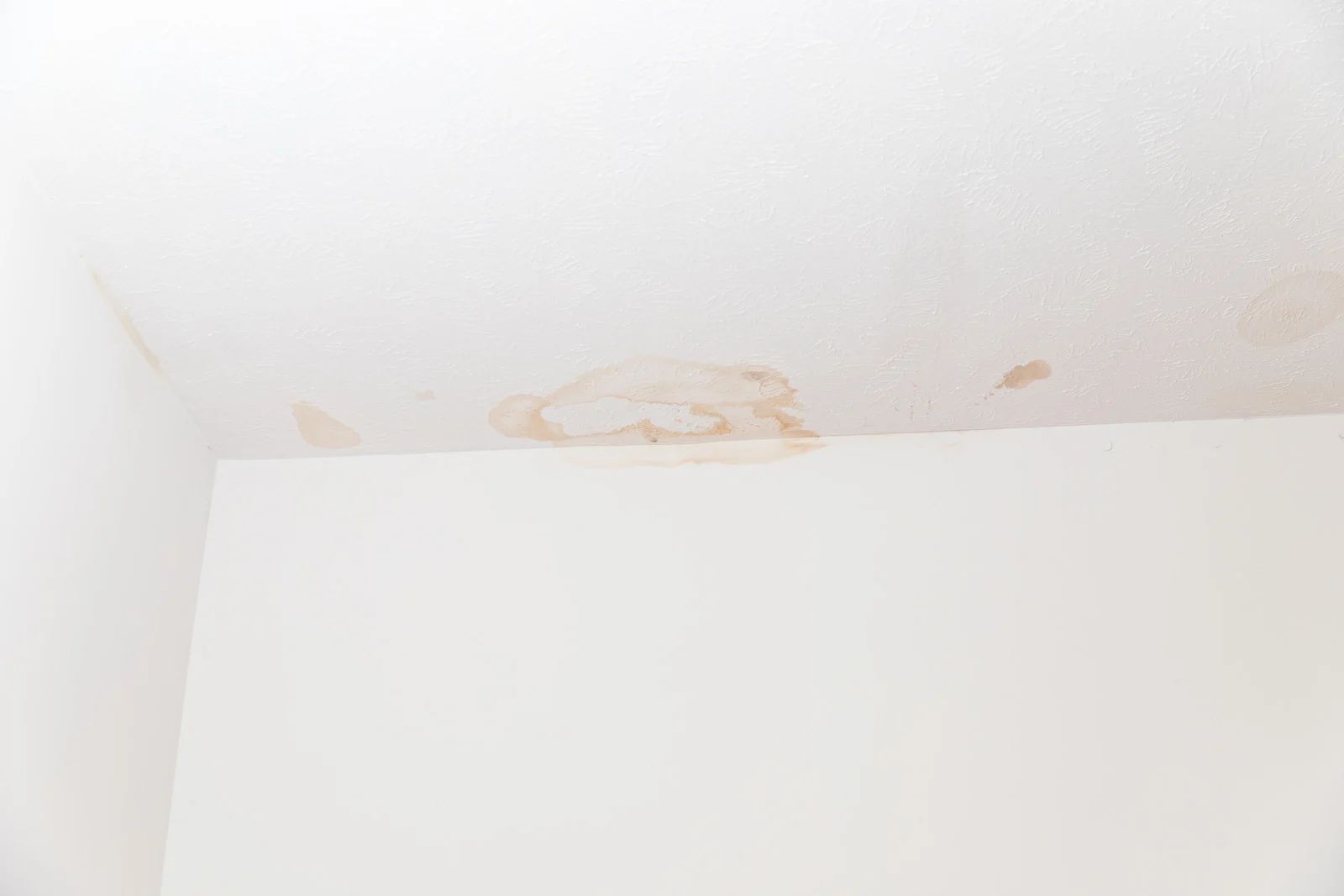
Quick Answer: Your ceiling stain that only shows up when the snow melts almost always traces back to one of three sources: meltwater backing up behind an ice dam at the eaves, condensation that built up as frost on the underside of your roof deck and let go during a thaw, or a flashing or valley leak that only shows itself once meltwater sits and ponds against it. Where the stain sits, how far it is from an exterior wall, and whether it shows up with every thaw or only the big ones, those clues tell you which one you're dealing with. The fixes are different for each. Figuring out which cause you're looking at matters more than the patch itself.
What Your Snowmelt Ceiling Stain Is Revealing
You've probably already ruled out the obvious answer. A stain that only appears when snow is melting, and stays dry the rest of the year, usually isn't a plumbing leak, and it's usually not a simple roof puncture either, since those tend to show up with any rain, not just meltwater. That rules out some possibilities. It doesn't answer the question, though, because three very different problems all produce the exact same symptom: a stain that seems to time itself to the thaw.
Here's the useful part. A stain that only shows up under specific conditions is giving you information whether you realize it or not. Where it sits on the ceiling, how it's shaped, what actually triggers it, a trained eye reads those details the way a mechanic reads a rattle. Below is how to start reading them yourself, so you've got a rough idea of what you're dealing with before anyone climbs a ladder.
Why the Timing Itself Is a Clue
Start with the fact that matters most: this stain doesn't show up with every rain. It shows up specifically when snow is melting. That timing alone rules some things out.
A roof leak from a plain, garden-variety failure, a cracked shingle, a puncture, a worn spot, usually leaks any time water hits it: heavy rain in July, a fall drizzle, snowmelt in March, doesn't matter. If your stain only acts up during a thaw and stays quiet the rest of the year, the cause depends on snow and cold specifically. That's a much shorter list. Ice damming needs snow and freezing temperatures at the roof edge by definition. Attic condensation builds up as frost during cold stretches and only becomes visible once it thaws. And flashing or valley leaks need standing water sitting against them for hours, something rain rarely provides but a slow snowmelt hands over constantly.
Each of those three leaves its own fingerprint once you know where to look. None of them are things worth ignoring, since every one means water is getting somewhere it shouldn't. But which one you're facing changes both the urgency and the fix.
Cause One: Meltwater Backing Up Behind an Ice Dam
The most familiar cause, especially if you've fought a heavy ridge of ice along your eaves before, is meltwater forced backward under the shingles by a dam.
Snow melts on the warmer upper roof, runs down, and refreezes once it hits the colder overhang at the eaves. That ice builds into a dam. Water melting behind it has nowhere to go but up and under the shingles, where it was never meant to be. Once it's in, gravity carries it along the roof deck until it finds a gap, a nail hole, a seam, and drips through onto the insulation and eventually the ceiling below.
The giveaway here is location. The stain tends to show up near an exterior wall, close to where the roofline overhangs the house, not out in the middle of a room. You'll often notice it after a stretch where ice built up visibly along the eaves or in the gutters, and it tends to get worse in heavier snow years. If you've already dealt with recurring ice dams on this roof, this is your prime suspect, though it's still worth confirming rather than assuming. The other two causes can show up in a similar general area.
Cause Two: Attic Condensation Letting Go During a Thaw
The second cause catches a lot of homeowners off guard, because it has nothing to do with a roof leak in the traditional sense. It's moisture from inside your own house.
Warm, humid air from bathrooms, kitchens, and living spaces rises. If it finds its way into the attic, through gaps around light fixtures, an attic hatch that doesn't seal well, or a bathroom fan vented into the attic instead of outside, that moist air hits the cold underside of the roof deck and condenses. In a Minnesota winter, that condensation doesn't just bead up. It frosts, sometimes heavily, coating the sheathing and rafters like a thin layer of snow that formed inside your own attic.
That frost sits there through cold stretches, frozen and unnoticed. Then a thaw comes, outside temperatures climb, the attic warms a few degrees, and all that frost melts at once. The water runs down the underside of the roof deck, soaks the insulation, and finds its way through to the ceiling right as the snow outside is melting too, which is exactly why this gets mistaken for a roof or ice dam problem so often.
The tell here is pattern. Condensation-driven stains are often more scattered than a single pinpoint spot, sometimes several small marks along a run of ceiling instead of one concentrated stain, and they tend to cluster near known moisture sources below, over a bathroom, near a kitchen, close to where a bath fan vents. They're also less tied to how much ice built up outside and more tied to how cold, and how long, the stretch was before the thaw hit.
Tip: If you can safely check your attic during or right after a thaw, look at the underside of the roof deck and the top of your insulation for damp or matted spots, especially over bathrooms and kitchens. Damp insulation with no visible roof damage above it points to moisture coming from inside the house, not from outside the roof.
Cause Three: Flashing and Valleys That Only Leak Under Standing Water
The third cause is the one most likely to get missed entirely, because nothing has to be obviously broken. It just needs meltwater sitting still long enough.
Flashing, the metal sealing transitions around a chimney, a skylight, a dormer wall, or where two roof planes meet in a valley, is built to shed water that's moving. A hard rain runs off a roof in minutes and it's gone. Snowmelt is a different animal. It can sit and pool against flashing, a valley, or a step-flashing seam for hours or days at a stretch as the pile above it slowly gives up its water. That prolonged contact gives water time to find a seam that's opened slightly, a fastener that's backed out, or sealant that's cracked, none of which would ever leak under a quick summer downpour but will absolutely leak under a slow-motion snowmelt sitting right against them.
Valleys get hit hardest because they collect runoff from two roof slopes at once. Snow lingers longest there and melts slowest, which is exactly the condition that exposes a weak seam. Chimneys and skylights are common trouble spots too, since the flashing around them involves more seams and transitions than a plain stretch of roof, and each one is a potential entry point once meltwater has had time to work at it.
The clue here is that the stain traces back to a specific feature rather than a general stretch of eave. It lines up under a valley, sits near a chimney chase, or shows up right below a skylight. It also tends to show up specifically during the heaviest melt events, a fast warm-up after a big snow, or rain falling on existing snowpack, rather than every time the temperature creeps above freezing.
Why Guessing at the Fix Rarely Works
It's tempting to patch the ceiling, repaint the spot, and hope the problem was a one-time thing. That almost never holds up. A stain that returns with every thaw means the source is still active, even during the months when it isn't visibly dripping.
Patching drywall without touching the source just delays the next stain while hiding the ongoing moisture in the meantime. Each of the three causes calls for a different fix: sealing flashing, correcting attic ventilation and air sealing, or fixing the conditions that let ice dams form in the first place. Treat the wrong one and the real source stays untouched while the actual damage builds behind the ceiling where you can't see it, soaked insulation, weakened roof decking, mold getting a foothold.
Warning: A ceiling stain that keeps returning every time the snow melts is a sign of ongoing moisture intrusion, not a single event. Left alone, that repeated wetting can rot roof decking and framing, ruin insulation's ability to hold heat, and create the conditions mold needs inside the wall and ceiling cavity, none of which show up until the damage is already well underway. The visible stain is usually the smallest part of the problem.
What an Inspection Actually Checks
A proper look at a thaw-triggered ceiling stain covers both the attic and the roof, because the source could be either one. Sometimes both are contributing at once.
From the attic side, that means checking the underside of the roof deck for frost, staining, or damp insulation, confirming bath and kitchen fans actually vent outside rather than dumping into the attic, and checking that insulation is even and that air sealing around penetrations, light fixtures, the attic hatch, is doing its job. From the roof side, it means examining the eaves for signs of past ice damming, checking flashing around chimneys, skylights, and dormers for gaps or lifted seams, and looking closely at valleys, since those tend to be where slow-draining meltwater causes the most trouble. Matching what shows up in the attic and on the roof to where the stain actually sits inside the house is what turns a guess into an accurate diagnosis. And an accurate diagnosis is what makes the fix actually stick instead of showing up again next thaw.
Frequently Asked Questions
Why does my ceiling stain only show up when the snow is melting, not when it rains?
Snowmelt creates conditions ordinary rain does not, including ice dam backup, thawing attic frost, and prolonged water around flashing or valleys. Because rain drains quickly, these moisture problems may remain hidden until winter temperatures rise again.
Could the stain be from something other than my roof or attic?
It is possible, but snowmelt timing strongly suggests a roof or attic issue. Plumbing problems can occasionally cause staining, yet consistent moisture appearing during thaws usually points toward ice dams, condensation, flashing, or vulnerable roof valleys.
Do I need to fix this before summer, or can it wait until next winter?
Addressing the problem before another winter helps prevent repeated moisture damage. Summer can be an ideal time for repairs because roofing conditions are drier, while damaged insulation, flashing, decking, or attic air leaks remain accessible for correction.
Can I just add more insulation to stop the stain?
Adding insulation may help when attic heat loss contributes to condensation or ice dams, but insulation alone rarely solves the problem. Air sealing, ventilation, flashing repairs, or other roofing corrections may also be necessary depending on cause.
Will one stain mean my whole roof has a problem, or is it usually isolated?
One stain often comes from a localized issue, such as a vulnerable valley, eave, flashing seam, or condensation area. However, broader ventilation or heat-loss problems can affect multiple roof sections, making a thorough inspection worthwhile for homeowners.
What should I do right when I first notice the stain?
Record when the stain appeared and whether it feels wet or dry. Avoid immediately repainting or covering it, since its location and condition provide useful clues about moisture sources, especially around exterior walls, valleys, and roof features.
Getting to the Source Before Damage Spreads
A ceiling stain that appears only during snowmelt is more than a cosmetic issue. Its timing can reveal whether meltwater is backing up behind an ice dam, attic frost is thawing, or water is finding a weakness around flashing or a valley. Identifying the actual source prevents repeated moisture from damaging insulation, roof decking, drywall, and framing. Woodland Roofing & Exteriors, LLC brings 30 years of experience serving the Brainerd Lakes and Twin Cities regions of Minnesota.
The most important detail is understanding why the stain appears under certain winter conditions rather than simply covering what shows on the ceiling. Its position, frequency, and relationship to snow accumulation can provide valuable clues about where moisture is entering or developing. Once the underlying cause is identified, repairs can address the conditions responsible for the problem instead of temporarily hiding the evidence. That approach helps protect the roof, attic, insulation, and interior through future Minnesota winters and seasonal thaws.